Noisy Data? Python Has a Filter for That

A practical intro to Kalman filters

πŸ‘‹ Introduction

This is pretty close to what I do every day.

How do you estimate something you can’t directly observe β€” when your data is noisy?

Why Python?

  • numpy makes the matrix maths readable β€” almost looks like the equations
  • matplotlib gives instant visual feedback while you’re building intuition
  • The whole filter fits in ~10 lines β€” no boilerplate, no ceremony
  • If you need more: filterpy, pykalman, scipy are one pip install away

πŸ‘‰ Python lets you focus on the idea, not the language

The Problem

  • We observe the world through sensors
  • Sensors are imperfect
  • Data is messy

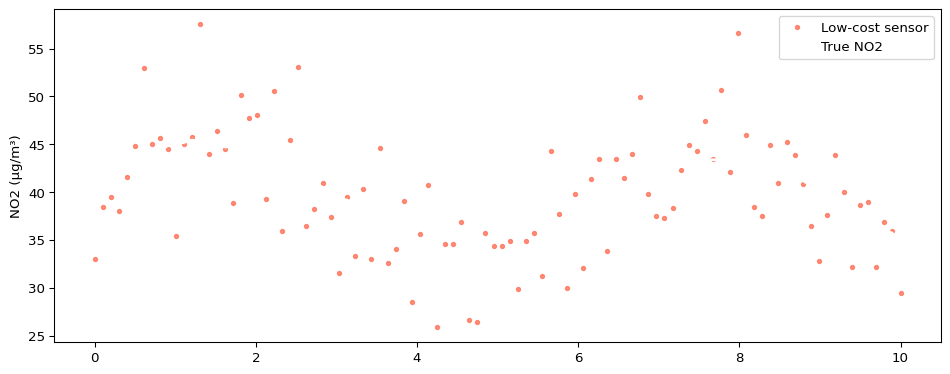
In our lab: we measure NO2 across a city with low-cost sensors.

They’re cheap enough to deploy everywhere β€” but noisy.

Example: Noisy NO2 Signal

What Do We Want?

  • Estimate the hidden state
  • Reduce noise
  • Do it in a principled way

Intuition

We have two sources of information:

  • Prediction (model)
  • Measurement (noisy)

πŸ‘‰ The key idea: combine them based on uncertainty

The Core Idea

Predict β†’ Measure β†’ Correct

State Model

\[x_k = A \, x_{k-1} + w_k\]

We predict the next state with some uncertainty.

Measurement Model

\[z_k = H \, x_k + v_k\]

We observe a noisy version of the state.

Update Step

\[x_k = x_k^- + K_k \underbrace{(z_k - H x_k^-)}_{\text{innovation}}\]

Prediction + correction

πŸ‘‰ Correction depends on how much we trust the measurement

Why Not Just Use a Library?

We could…

But we needed:

  • More control over the model
  • Access to internals
  • To extend the method

πŸ‘‰ So we built a small version ourselves

From Equations to Code

Equations

\[x_k^- = A \, x_{k-1}\] \[P_k^- = A P_{k-1} A + Q\]

\[K_k = \frac{P_k^-}{P_k^- + R}\]

\[x_k = x_k^- + K_k(z_k - x_k^-)\] \[P_k = (1 - K_k) P_k^-\]

Python

x_pred = A * x
P_pred = A * P * A + Q

K = P_pred / (P_pred + R)

x = x_pred + K * (z - x_pred)
P = (1 - K) * P_pred

πŸ‘‰ One equation, one line β€” that’s it

Vanilla Loop

x, P = 40.0, 10.0
A, H = 1, 1
Q    = 0.3
R    = 25.0    # sensor noise variance (std β‰ˆ 5 ΞΌg/mΒ³)

estimates = []

for z in meas:
    # Predict
    x_pred = A * x
    P_pred = A * P * A + Q

    # Update
    K = P_pred / (P_pred + H * H * R)
    x = x_pred + K * (z - H * x_pred)
    P = (1 - K * H) * P_pred

    estimates.append(x)

Let’s Wrap This in a Class

class KalmanFilter1D:
    def __init__(self, x0, P0, A, H, Q, R):
        self.x, self.P = x0, P0
        self.A, self.H, self.Q, self.R = A, H, Q, R

    def predict(self):
        self._xp = self.A * self.x
        self._Pp = self.A * self.P * self.A + self.Q

    def update(self, z, R=None):
        R      = R if R is not None else self.R
        K      = self._Pp / (self._Pp + self.H * self.H * R)
        self.x = self._xp + K * (z - self.H * self._xp)
        self.P = (1 - K * self.H) * self._Pp

    def step(self, measurements):
        self.predict()
        for z, R in (measurements if hasattr(measurements, '__iter__')
                     else [(measurements, self.R)]):
            self.update(z, R)

    def filter(self, measurements):
        for z in measurements:
            self.step(z)
        return np.array(self._xs)

    # + smooth() for RTS β€” coming up

Using the Class

kf = KalmanFilter1D(
    x0=40.0, P0=10.0,
    A=1, H=1,
    Q=0.3, R=25.0
)

estimates = kf.filter(meas)

fig, ax = plt.subplots(figsize=(6, 4))
ax.plot(t, meas,      '.', color="tomato",    label="Sensor",   alpha=0.6)
ax.plot(t, true,      '-', color="white",     label="True NO2", linewidth=2)
ax.plot(t, estimates, '-', color="limegreen", label="Filtered", linewidth=2.5)
ax.set_ylabel("NO2 (ΞΌg/mΒ³)")
ax.legend()
plt.tight_layout()
plt.show()
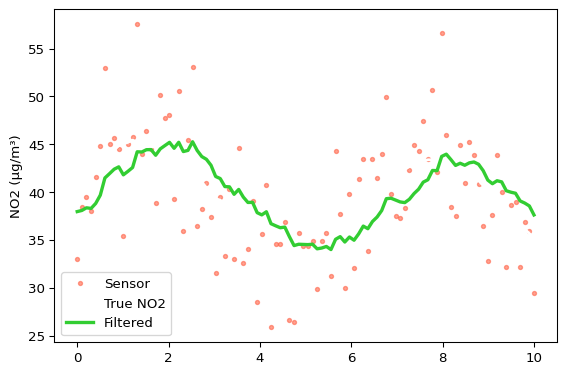
This is great… but

Kalman filtering only uses:

πŸ‘‰ past + current data

What If We Have All the Data?

Offline setting β€” sensor logs processed overnight:

  • We already have the full time series
  • Can we do better?

πŸ‘‰ Yes β€” smoothing

Key Idea: Smoothing

  • Forward pass β†’ Kalman filter
  • Backward pass β†’ refine estimates

πŸ‘‰ Use future information to improve past estimates

RTS Smoother

\[x_k^s = x_k + C_k \left( x_{k+1}^s - x_{k+1}^- \right)\]

πŸ‘‰ We adjust estimates using future information

Adding smooth() to the Class

    def smooth(self):
        xs, Ps         = np.array(self._xs),     np.array(self._Ps)
        xpreds, Ppreds = np.array(self._xpreds), np.array(self._Ppreds)
        smoothed = xs.copy()

        for k in range(len(xs) - 2, -1, -1):
            C           = Ps[k] * self.A / Ppreds[k+1]   # smoother gain
            smoothed[k] = xs[k] + C * (smoothed[k+1] - xpreds[k+1])

        return smoothed

Filter β†’ Smooth

kf2 = KalmanFilter1D(
    x0=40.0, P0=10.0,
    A=1, H=1, Q=0.3, R=25.0
)
kf2.filter(meas)
smoothed = kf2.smooth()

fig, ax = plt.subplots(figsize=(6, 4))
ax.plot(t, meas,           '.', color="tomato",    label="Sensor",   alpha=0.5)
ax.plot(t, true,           '-', color="white",     label="True NO2", linewidth=2)
ax.plot(t, kf2.estimates,  '-', color="limegreen", label="Filtered", linewidth=2, alpha=0.7)
ax.plot(t, smoothed,       '-', color="gold",      label="Smoothed", linewidth=2.5)
ax.set_ylabel("NO2 (ΞΌg/mΒ³)")
ax.legend()
plt.tight_layout()
plt.show()
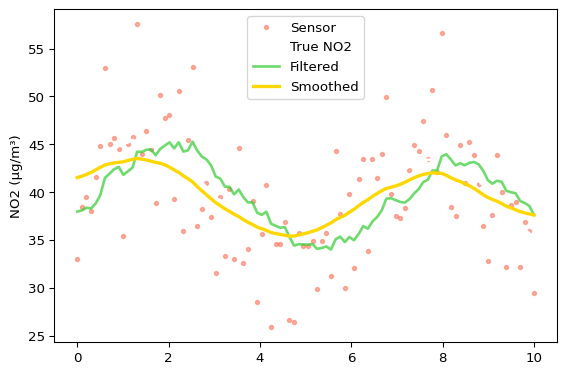
Filtering vs Smoothing

Filter RTS Smoother
Data used past + present full series
Use case real-time offline reanalysis
Accuracy good better

πŸ‘‰ Same model β€” just more information

State Space Models β€” The Bigger Picture

The Kalman filter is a state space model.

A state space model has two parts:

\[x_k = A \, x_{k-1} + w_k \quad \text{(transition β€” how state evolves)}\] \[z_k = H \, x_k + v_k \quad \text{(observation β€” what sensors see)}\]

  • ARIMA can be rewritten as a state space model β€” statsmodels does this internally
  • Kalman filter = inference in a linear Gaussian state space model
  • RTS smoother = full posterior over the state given all observations

πŸ‘‰ State space is the framework β€” Kalman is the efficient algorithm to solve it

What About ARIMA / Prophet?

ARIMA / Prophet Kalman Filter
Primary goal Forecasting State estimation
Multiple sensors No Yes β€” built in
Uncertainty Confidence intervals Propagated at every step
Real-time updates Refit needed Natural β€” just run the loop
Physics/domain model No Yes β€” you define A, Q

πŸ‘‰ ARIMA asks β€œwhat comes next?”

πŸ‘‰ Kalman asks β€œwhat is true right now, given noisy observations?”

Libraries

  • pykalman
  • filterpy
  • statsmodels

πŸ‘‰ These implement filtering and smoothing

But: building it once makes it much clearer

Fun Fact πŸš€

The Apollo Guidance Computer used a Kalman filter.

πŸ‘‰ You can read the original code on GitHub.

  • ~2 MHz processor
  • ~4 KB RAM
  • Still doing state estimation

If it worked there, it’ll work for our NO2 sensors.

Why Build It Yourself?

  • Understand the mechanics
  • Debug and trust results
  • Extend when needed
  • Not everything is exposed in libraries

Let’s Try It on Real Data

So far β€” simulated signals.

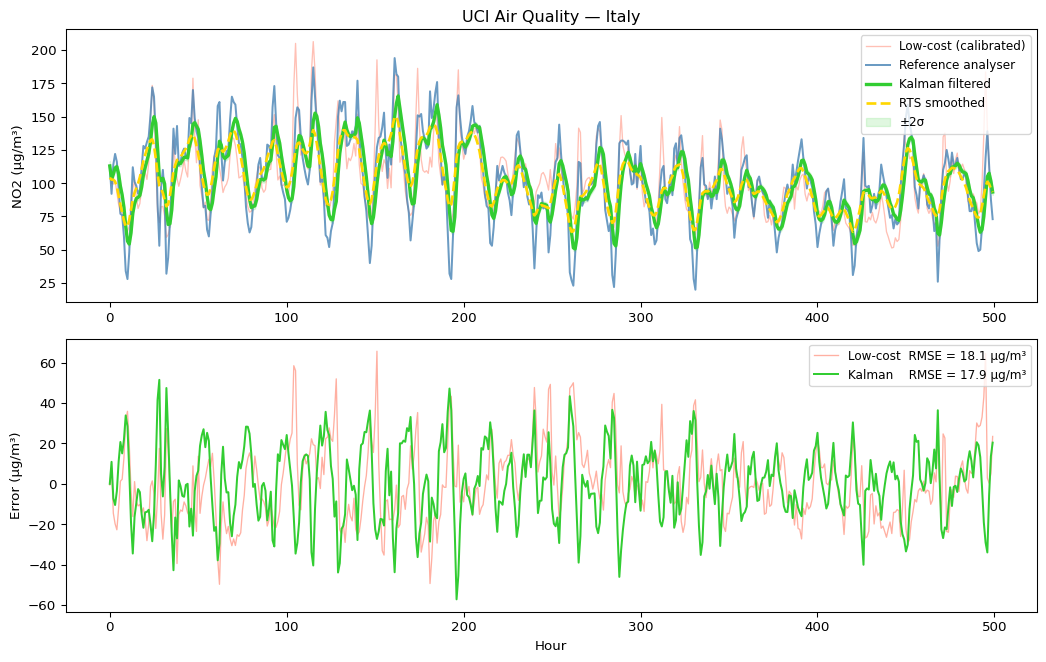
UCI Air Quality dataset β€” collected in an Italian city

  • Hourly NO2 readings over one year
  • One low-cost metal oxide sensor alongside a reference analyser
  • Exactly the setup we have in the lab

Two things to do before fusing:

  1. Handle missing values (-200 sentinel in this dataset)
  2. Calibrate the sensor β€” it returns raw resistance, not ΞΌg/mΒ³

Real Data β€” Load & Calibrate

df         = load_uci_airquality("data/AirQualityUCI.csv")
sensor_cal = calibrate_sensor(df["no2_sensor"], df["no2_ref"])

Fusing Two Sensors β€” step()

R_ref, R_sensor = 4.0, 50.0   # reference is much more precise

kf_real = KalmanFilter1D(
    x0=float(df["no2_ref"].iloc[0]), P0=20.0,
    A=1, H=1, Q=0.5, R=R_ref
)

for z_ref, z_lc in zip(df["no2_ref"], sensor_cal):
    kf_real.step([(z_ref, R_ref), (z_lc, R_sensor)])

smoothed_real = kf_real.smooth()

Result: Real Fusion

Back to Our Lab

We run the same approach with our own sensors:

  • Multiple low-cost NO2 sensors β€” high density, noisy
  • A few regulatory analysers β€” sparse, very accurate

The filter fuses them: cheap sensors benefit from reference accuracy without being overwritten.

Takeaways

  • Kalman filter = predict + correct
  • RTS smoother = refine using future data
  • Simple ideas β†’ powerful results

Build it once from scratch β€” you’ll trust it much more

Thanks πŸ™Œ

Questions?

Code from this talk: kalman_talk.qmd